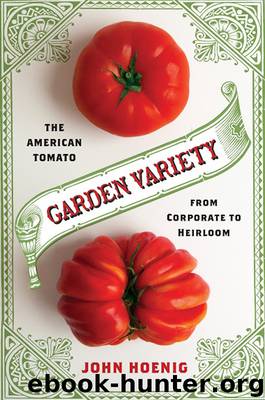
Garden Variety by John Hoenig
Author:John Hoenig
Language: eng
Format: epub
Publisher: Columbia University Press
POPULARITY OF FARMERS’ MARKETS AND HOME GARDENING, 1945–PRESENT
The rise of farmers’ markets and home gardening is a complex, even surprising, story given the economic forces that drove the food industry. In fact, during the decades following World War II, both farmers’ markets and home gardening went into decline. Farmers’ markets began their decline as early as the 1930s, as the Great Depression wreaked havoc on small farmers throughout the country. Providing an accurate count of farmers’ markets in the United States over time is a difficult task. Numerous scholars have attempted to complete such a project, but with varying definitions of what a farmers’ market is and with inadequate regulations and reporting of farmers’ market activity, providing an accurate count of farmers’ markets has proven illusory. Nevertheless, scholars agree that the postwar period saw a continued decline in farmers’ markets, as the dual forces of suburbanization and centralization of agriculture formed serious impediments to the existing local market tradition in the United States. Resellers rather than farmers most often populated urban markets that survived, hawking goods bought on the wholesale market, often produced hundreds, if not thousands, of miles away.6
The tenuous position of farmers’ markets in the 1950s and 1960s represents more than a half-century of “progress” in American agriculture, fueled by the forces of economic and geographic centralization. As historian Jane Pyle noted rather pessimistically in her 1971 “Farmers’ Markets in the United States: Functional Anachronisms”: “A prescient person of the 1890’s could have foreseen that the public market was doomed by a changing society. The railroads connected eastern population centers with distant open lands, where favorable climate and cheap labor joined forces to stock the urban larder.” Where the steam locomotive sounded the death knell for many local agricultural economies in the late nineteenth century, during the middle of the twentieth century, as Shane Hamilton has argued, a wave of centralized distribution was made possible by the emergence of the trucking industry and the interstate highway system. New agricultural technologies and large government-funded irrigation projects in the western United States threatened the existence of local and regional foodways.7
Unlike farmers’ markets, home gardening remained popular throughout World War II, but by the late 1940s, and continuing at least through the 1960s, it, too, declined. In 1950, for example, agricultural experts reported that Rockland County, New York, home to around nine thousand Victory Gardens during World War II, had seen a 40 percent decline in home gardens and a 50 percent decrease in garden size. A look at popular gardening magazines such as Better Homes and Gardens indicates a much greater interest in lawn care and other yard beautification rather than home food production during the 1950s and 1960s. Even as Secretary of Agriculture Charles F. Brannan announced the establishment of the “Liberty Gardens” program in 1951, which focused on maintaining the popularity of vegetable and fruit gardens, a survey found that only 6.9 percent of New York City residents, and just over 30 percent of New York suburban and rural residents, planted gardens.
Download
This site does not store any files on its server. We only index and link to content provided by other sites. Please contact the content providers to delete copyright contents if any and email us, we'll remove relevant links or contents immediately.
The Brazilian Economy since the Great Financial Crisis of 20072008 by Philip Arestis Carolina Troncoso Baltar & Daniela Magalhães Prates(371922)
International Integration of the Brazilian Economy by Elias C. Grivoyannis(111668)
The Art of Coaching by Elena Aguilar(53731)
Flexible Working by Dale Gemma;(23366)
How to Stop Living Paycheck to Paycheck by Avery Breyer(19843)
Thinking, Fast and Slow by Kahneman Daniel(12563)
The Acquirer's Multiple: How the Billionaire Contrarians of Deep Value Beat the Market by Tobias Carlisle(12441)
The Radium Girls by Kate Moore(12218)
The Art of Thinking Clearly by Rolf Dobelli(10744)
Hit Refresh by Satya Nadella(9270)
The Compound Effect by Darren Hardy(9177)
Tools of Titans by Timothy Ferriss(8627)
Atomic Habits: Tiny Changes, Remarkable Results by James Clear(8538)
Turbulence by E. J. Noyes(8237)
A Court of Wings and Ruin by Sarah J. Maas(8143)
Change Your Questions, Change Your Life by Marilee Adams(7949)
Nudge - Improving Decisions about Health, Wealth, and Happiness by Thaler Sunstein(7874)
How to Be a Bawse: A Guide to Conquering Life by Lilly Singh(7656)
Win Bigly by Scott Adams(7360)
